
Learning Through Play: Four Educational Games Your Child Will Love
Looking for fun ways to keep learning alive this summer? Discover four educational games that help children build spelling, vocabulary, and math skills while having fun with family and friends.
6/4/20263 min read
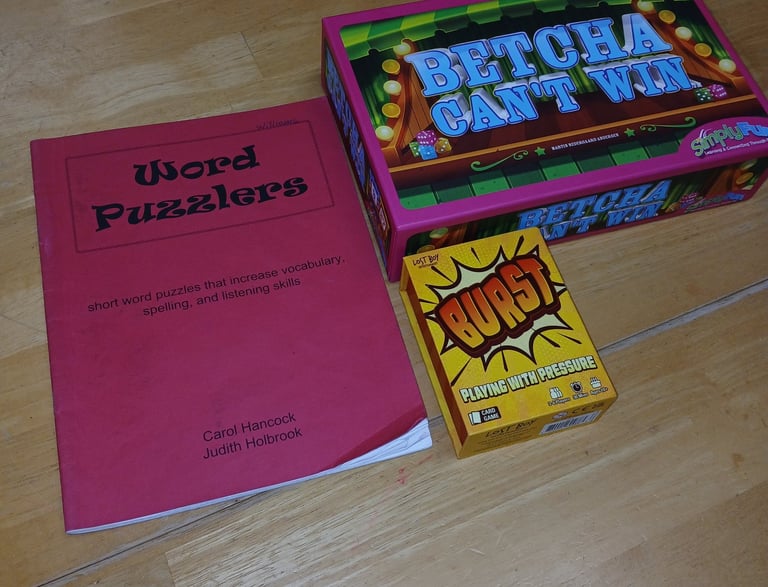
As both a teacher and tutor, I am always looking for ways to make learning fun. While worksheets and traditional practice certainly have their place, some of the best learning happens when students are engaged in a game. Educational games help children practice important skills while building confidence, problem-solving abilities, and a love of learning.
Here are four of my favorite learning games—two that strengthen reading and vocabulary skills and two that build math skills.
1. Boggle: Building Stronger Spellers
Boggle has been one of my favorite word games for years. It is best suited for students in 3rd grade and above, although younger students can play with some support.
The game consists of a grid of lettered cubes. Players race against the clock to find as many words as possible by connecting adjacent letters. While children are having fun searching for words, they are also strengthening important literacy skills such as:
Spelling patterns
Vocabulary development
Word recognition
Visual scanning skills
I especially like Boggle because it encourages students to look closely at letter combinations and experiment with creating words. The more they play, the more confident they become in recognizing common spelling patterns.
2. Word Puzzlers: Vocabulary Fun with Clues
Another favorite activity comes from a book of word puzzles published by DGP Publishing. In these puzzles, students are given a set of letters and a clue.
For example, they may receive the letters:
R, S, A, U, B, D
Along with the clue:
"Make a three-letter word that is an antonym for good."
The answer is bad.
What makes these puzzles especially engaging is that the words often build upon one another throughout the activity. A student may solve one word and then use some of those same letters to create a new word based on the next clue. As the puzzle progresses, students continually manipulate letters, think about word meanings, and make connections between words.
These puzzles are excellent because they require students to think about vocabulary, spelling, and critical thinking all at the same time. Children must analyze the clue, consider possible meanings, and rearrange letters to form the correct word.
What I love most about these puzzles is that they naturally build vocabulary while feeling more like a game than an assignment. Students often become so focused on solving the next clue that they don't realize how much they are strengthening their language skills.
3. Betcha Can't Win: Making Addition Exciting
One of my newest math game discoveries is Betcha Can't Win from SimplyFun.
In this game, players roll six dice and try to capture number cards by creating sums that match the values shown on the table. The challenge is deciding how to combine the dice to collect the most valuable cards.
While students are focused on winning, they are also practicing:
Addition fluency
Number sense
Mental math
Strategic thinking
Many students enjoy this game because it feels fast-paced and competitive. It's a wonderful way to strengthen addition skills without completing another worksheet.
4. Burst: Strategy Meets Math
Another recent favorite is Burst by Lost Boy Entertainment.
The goal is simple: make your opponents go over 21 before you do. Players must carefully consider each move, deciding whether to play it safe or take a risk.
As students play, they practice:
Addition
Number sense
Estimation
Strategic decision-making
Games like Burst help children develop mathematical thinking in a natural way. They learn to evaluate options, predict outcomes, and calculate totals quickly.
Why Learning Games Matter
One of the biggest benefits of educational games is that they create positive experiences around learning. When children are laughing, thinking, and interacting with family members, they are often more willing to take academic risks and try challenging tasks.
As a tutor, I often encourage families to include educational games as part of their regular routine. A family game night can provide meaningful practice without feeling like schoolwork. In fact, many students are surprised to learn how much reading, vocabulary, and math they are using while they play.
Whether your child is building spelling skills with Boggle, expanding vocabulary through word puzzles, adding dice totals in Betcha Can't Win, or strategizing in Burst, they are strengthening important academic skills while having fun.
This summer, consider adding a few educational games to your family's routine. A game night can become a valuable learning opportunity—and your child may not even realize they're practicing reading and math along the way!